
Who Owns a Clark County Parcel?
Clark County answers in two steps. Start with Beacon Interactive Mapping for any address. It returns the parcel tied to that address plus an owner drawn from the assessor or Real Property Lister record. The newest deed names the grantee. When the parcel card and the deed disagree, compare the recording date and the legal description before relying on either.
- Search the property's situs address in Beacon and copy the parcel number and legal description.
- Read the owner-of-record field if the current parcel card shows one.
- Search the latest deed by grantee or land description and compare the recording date.
- If an entity holds title, check its public business filing for name context, not as proof of the parcel.
Clark County Owner Record and Deed
The county advertises Beacon searches three ways. You can look up an owner by name, by address, or by parcel number. Treat any owner name you find there as a starting point. The Treasurer and Real Property Lister update the parcel record only after a transfer is recorded. The county publishes no exact refresh interval. A recent grantee can therefore appear in the deed index before the assessor view catches up.
The Clark County Register of Deeds records instruments that give public notice. The office also preserves title history. To confirm ownership, match the newest deed's grantee against the legal description. Then check the parcel card. A street address alone will not do. A deed may cover a platted lot, a CSM, or a rural parcel whose postal city differs from the municipality. The legal description settles the match.
Clark County LLC and Estate Owners
A Clark County deed may name an LLC, a trustee, a personal representative, or an estate. Keep the recorded name exactly as written. Wisconsin's Department of Financial Institutions business search can show an entity's status, filing history, registered agent, and office address. Those details help interpret a grantee name. A registered agent is not necessarily a beneficial owner. The business record also does not list every parcel an entity owns.
For an estate transfer, Wisconsin Circuit Court Access can point to a probate case summary. The Register in Probate holds the full file. Title moves only by a recorded deed or court order. A death certificate does not convey real property. When similar owner names pile up, compare entity suffixes, dates, and legal descriptions rather than merging them.
Where Clark County Ownership Appears
Ownership clues sit in different Clark County systems. Beacon links an address to a parcel and its assessment record, while GIS shows where the parcel sits. The Register of Deeds records the transfer itself. WCCA can surface a foreclosure or probate case summary. Each source answers a narrower question, and the recorded deed remains the direct record of a conveyance.
| Source | Owner Info It Gives | Access |
|---|---|---|
| Beacon parcel record | Owner and address search links, exact card fields unverified | County interactive map |
| Register of Deeds | Grantee and grantor named on a recorded instrument | LandShark, ColorTract, Tapestry, or office |
| WCCA / probate file | Court case context that may explain a transfer | Public summary and local clerk file |
| GIS map | Parcel location and mapped neighbors | Beacon and printed atlases |
The owner of record may not live there. A mailing address is not the situs. A tax notice may go to a manager, a trustee, another residence, or a tax-service address. The record is not a resident directory. It does not prove that a named person is present at the parcel.
When a result names an LLC, a trust, or an estate, preserve the exact vesting language from the deed first. Wisconsin's business-entity search can confirm a filing name, a status, a registered agent, or an office address. It will not name a beneficial owner. A trustee, member, attorney, or registered agent can appear in an entity record without holding the land personally. The legal description is the key. The recorded instrument is the property-specific evidence.
Clark County Situs and Mailing Clues
Clark County spreads its parcels across 46 municipalities, a mix of cities, villages, and towns. That mix trips up address searches. A mailing city can include rural land outside the city boundary. Rural emergency addresses are set through county Land Information. Compare the situs, mailing address, municipality, and tax district separately. Each field answers a different question. A street or ZIP can start a lookup, but it cannot tell you which city permit office or county recorder holds the relevant file.
Abbotsford needs an extra county check because it is split between Clark and Marathon counties. Check the county line first. A city-name search can lead you to the wrong recorder if the parcel sits across the line. Confirm the county, full parcel ID, and legal description before requesting a deed. For Neillsville or Thorp, check whether the parcel lies in the city or in a surrounding town before using a municipal permit route.
For a possible foreclosure, probate, or judgment transfer, WCCA offers case summaries searchable by party name, business, county, and case number. The summaries update hourly. They are not the complete court file, though. Older record depth varies by county. Use a docket to identify the case. Then match its lis pendens, judgment, or sheriff's deed to the parcel in the Register of Deeds index. A case involving someone with the same name is not enough to assign that event to a property.
If an online search misses an older instrument, Wisconsin Public Records Law generally permits an oral request to the record custodian, though a specific record or security rule may require writing. The office must respond promptly. The law sets no single fixed deadline, only a ban on unnecessary delay. Ask about actual copy and retrieval costs up front. Direct the request to the county office itself.
Match Clark County Owners to Land
Read the vesting exactly as recorded. Two grantees, a trustee, a personal representative, and an LLC are all different name forms. Parcel-card labels shorten or normalize them. Preserve punctuation, middle initials, entity endings, and representative wording when you search backward. A business filing can separate similar entity names. It still cannot prove that a named person is the beneficial owner of the land. The deed's parties and complete land description remain the true link between a name and a Clark County parcel.
Connect a person or entity to a parcel through the complete legal description, never a similar name alone. The local parcel number carries an owner result between Beacon and the tax roll. The deed description identifies what the grantor conveyed. Watch the wording closely. If the description names a lot, plat, or certified survey map, compare that exact wording with the recorded map before treating a name match as ownership of the whole current parcel.
The Clark County deed-records guide explains how to move from a grantee entry to the recorded instrument. For an owner question, keep the name as written, the recording date, the instrument reference, and the parcel description together. Each detail locks the others in place. A map outline can orient the check. It is not a title determination.
When Clark County Ownership Changes
Clark County publishes no assessor refresh schedule. A transfer becomes a recorded event when the deed is filed. The Treasurer / Real Property Lister then works the change into parcel records. Do not treat tax settlement dates as the deadline. If a closing is very recent, search the deed index by the new grantee or legal description. Ask the Register of Deeds whether the instrument has been indexed.
Once a record exists, the county-linked Property Fraud Alert can send a notice whenever an instrument is recorded under a monitored name. It is a notification aid. It is not title insurance. It will not correct a false filing either. Read the actual document whenever a notice arrives. Contact the Register of Deeds if it does not match an expected transfer.
Enroll or review the Clark County Property Fraud Alert service.
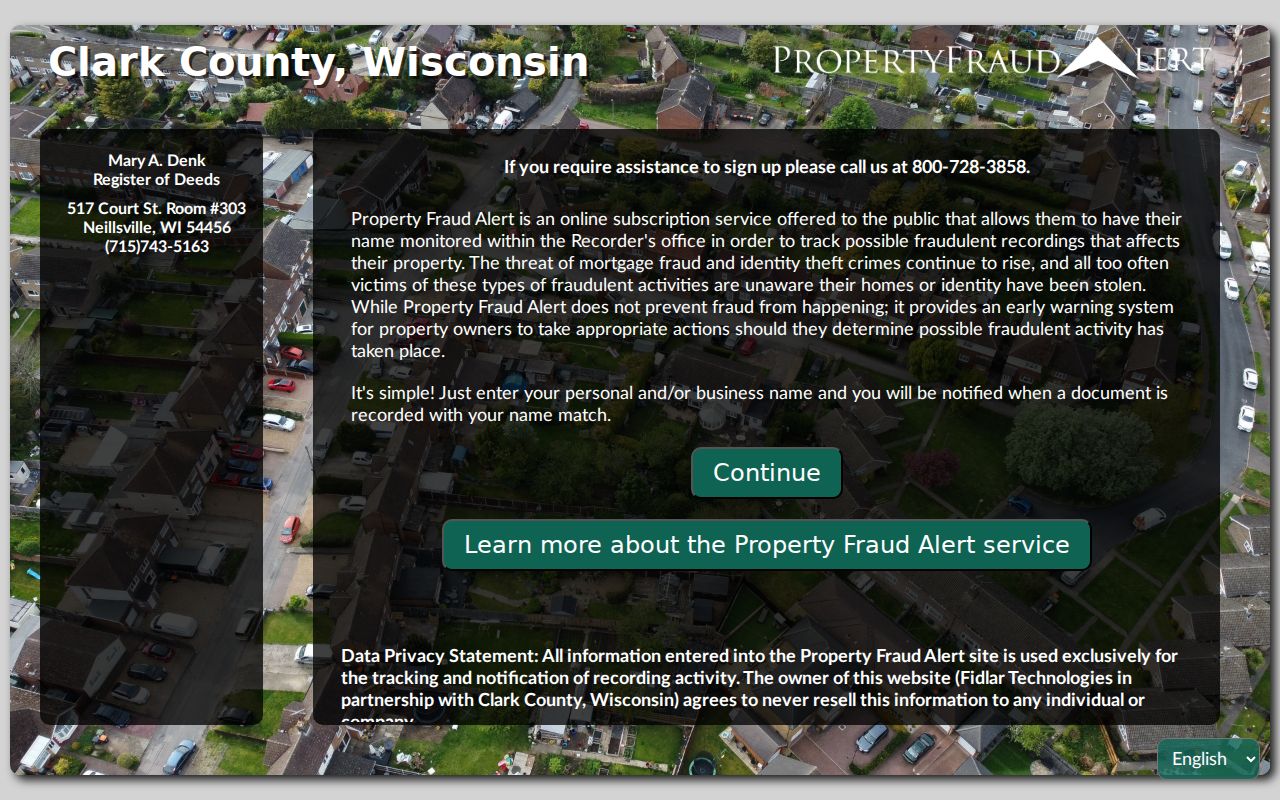
The alert page ties notices to a recorded name. It cannot replace reviewing the deed image or asking the county office for help.
Limits on Clark County Owner Searches
An owner lookup has firm limits in Clark County. It cannot show who lives at a parcel, settle a title dispute, or reveal every private or unrecorded arrangement. Wisconsin Public Records Law favors access. It also allows statutory limits, redactions, and a balancing test. Safe at Home offers an address-confidentiality route for eligible survivors when an agency accepts its substitute address. Ask the custodian about protected-address rules first.
A name match does not define the full interest. Check the recorded instrument for the named grantee, the land described, and any stated co-owner or representative capacity. A parcel-card owner entry is a useful locator. It cannot show every encumbrance or resolve whether a conveyance covered the whole parcel. A title professional reviews the chain and exceptions when that conclusion matters.
Lawful use. Use owner information for a property question, purchase diligence, or civic research. Do not use a Clark County record to track, threaten, or harass a person.