
Clark County Property Tax Records
Two halves make up Clark County property tax records: assessment data and collection data. The Treasurer, doubling as Real Property Lister, keeps the parcel and tax-roll side. The office incorporates transfers and plats. It also incorporates certified survey map changes recorded with the Register of Deeds. The county publishes no archive of past tax bills. Use the current tax bill and the official county links for payment instructions. A public historical bill database should not be assumed.
| Field | What It Shows | Where |
|---|---|---|
| Assessment roll | Land, improvement, and total assessment, where the parcel record displays them | Beacon and municipal assessor |
| Tax bill | Amount due and payment directions printed on the bill | Clark County Treasurer |
| Tax district | Municipal and taxing-unit context for the parcel | Treasurer / Real Property Lister |
| Delinquency | Unpaid tax status and tax-deed process records | Treasurer and county notices |
| Recorded change | Transfer, plat, or CSM that can change the parcel record | Register of Deeds, then Lister update |
Wisconsin Statute §70.32 bases property assessments on market value. A tax bill is not a market appraisal. It reflects the assessed property, the local levy, and the tax district. A valid recent sale can hint at market conditions, but one transaction does not automatically reset that parcel's assessment.
Clark County Treasurer and Parcel Roll
The Clark County Treasurer wears two hats: collecting taxes and maintaining real-property listing information. Parcel records get updated after the Register of Deeds records a transfer. Plats and certified survey maps trigger description changes too. That workflow ties the tax roll to recorded land documents. It does not promise every system changes the same day.
The Treasurer's page counts about 33,000 real-estate parcels across 46 municipalities. Local treasurers post collections in December and January. County tax settlements wrap up by February 20. Those dates describe collection and settlement work, not an owner-record refresh deadline, so a new owner should check the bill and the newest recorded instrument.
Clark County Assessment Measures
Wisconsin separates two measures. The assessment level compares a municipality's total assessed value with its equalized value. A parcel ratio works differently. It compares that parcel's assessed value with fair market value. A countywide ratio therefore cannot prove one Clark County parcel is over- or under-assessed.
The Department of Revenue's 2025 Statistical Report supplies a Statement of Assessment for each municipality. It also provides a Summary of Aggregate Ratios. The sample math is simple. It divides a $140,000 assessment by a $150,000 market value, or 93 percent. DOR cautions that the ratio approach does not fit agricultural land the same way. That exclusion covers agricultural forest and undeveloped land too. Clark County posts no revaluation-year list.
Review the official Wisconsin DOR assessment-ratio and statistical reports.
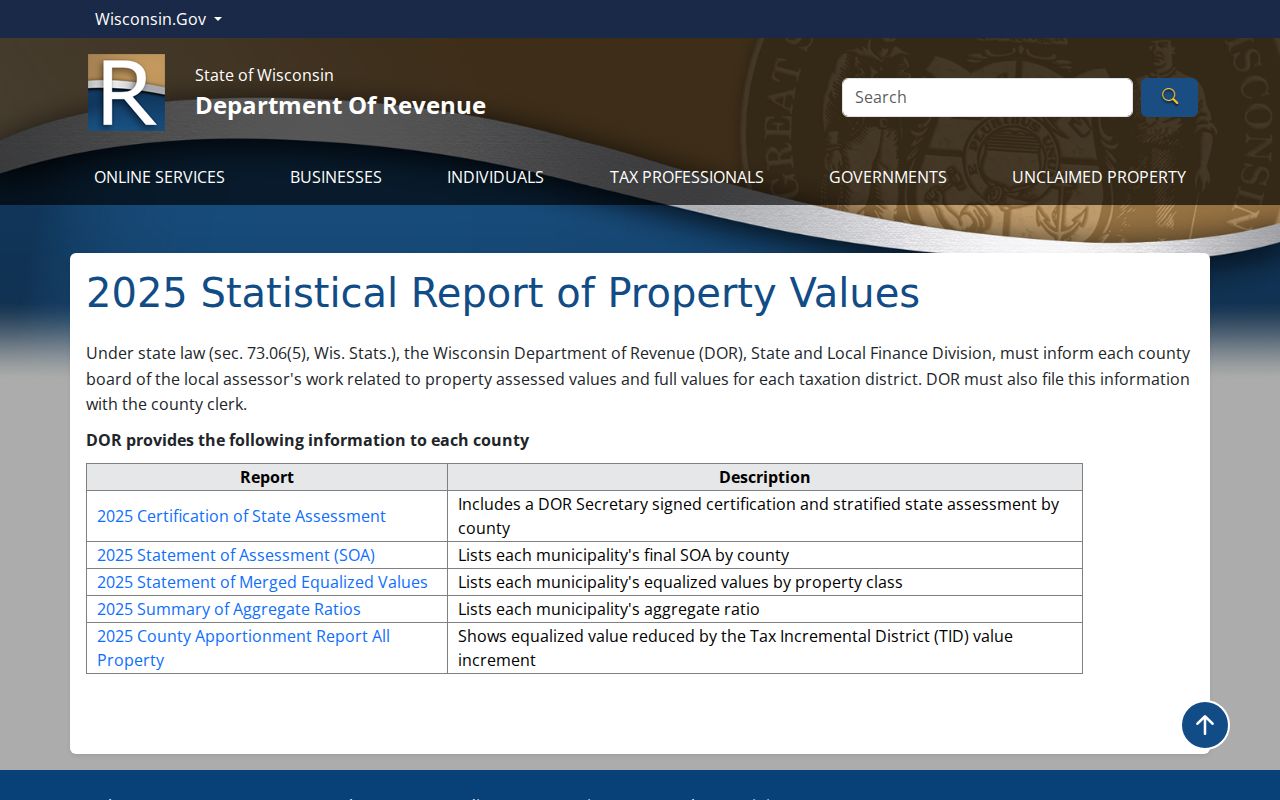
The DOR report helps compare municipalities and assessment patterns. It cannot replace a parcel card, tax bill, or local assessor review for any single Clark County parcel.
Clark County Exemptions and Tax Credits
Exemptions and credits change how a parcel's tax bill is calculated. They are not ownership records. Neither one amends the recorded deed. Clark County publishes no complete exemption list. Which credit labels appear in Beacon or on the public tax-bill route is also unclear. Do not infer anything from a missing field.
Start with one tax year. Copy the parcel ID and the exact wording from the bill or assessment notice. Classification questions go to the municipal assessor. Bill and payment questions go to the Treasurer. Eligibility and filing rules depend on the program and year. Rely on the current official notice, not an older bill or a countywide assumption.
Keep the assessed value, taxable basis, levy, and amount due distinct on any bill. A credit can change the math. It does not touch the recorded deed. A delinquent-tax certificate is a separate stage. The exact exemption inventory for Clark County is not published, so the current bill's line names and tax year are the right starting point for questions to the assessor or Treasurer.
Clark County Assessment Review
A wrong-looking assessed value deserves a challenge. Start with the municipal assessor. Ask for the current assessment record. Ask for the valuation date and the local Board of Review schedule too. Clark County publishes no countywide appeal deadline or single last-revaluation year. So do not rely on an old calendar. Each municipality's notice and assessor contact control the current procedure.
Strong evidence stays tied to the parcel and valuation period. Useful items include the assessor's property facts. A recent arm's-length sale helps. So does comparable property information and corrections to land or improvement details. Wisconsin DOR says assessors analyze valid sales and market conditions. A sale helps measure assessment level and uniformity during maintenance work. It does not automatically change only the sold parcel.
Finding a Clark County Tax Bill
Start with the parcel, not the street name. A parcel number pins down the right tax bill. Beacon serves as Clark County's linked search for addresses, owners, and parcels, while the Treasurer's tax links and printed bill instructions govern payment details. The Treasurer posts no public inventory of historical tax-bill fields. If the portal skips the year or status you need, ask for the existing record. Send the parcel number and tax year.
- Find the parcel in Beacon and copy its full local parcel number.
- Open the Treasurer's current tax links or use the bill already sent for that parcel.
- Check the name, mailing address, tax year, and amount on the bill.
- If delinquent, confirm payment instructions with the Treasurer and check the separate tax-deed record trail.
- Assessed value
- The municipality's recorded value for the parcel under Wisconsin assessment rules.
- Levy
- The amount raised by a taxing unit; the bill applies local tax rates to the parcel's taxable basis.
- Tax district
- The collection area that helps determine which local units are reflected on a parcel's bill.
- Tax certificate
- A record in the county's delinquent-tax process before possible tax-deed proceedings.
Clark County Delinquent Tax Timeline
Clark County's tax-deed process moves in steps rather than one auction. Tax certificates are issued on September 1. Redemption notices are published, and a title search is performed. Lien holders get official notice before the sale. Each step creates a different record: Treasurer material, a newspaper notice, title-search work, court records, and a deed filed with the Register of Deeds. The current tax-deeded-land search fields are not published. Neither are the auction columns, redemption calendar, bid process, or copy fees. Check the Treasurer page and the county document center. Then call the specific Treasurer number shown there. A tax-sale list is never a complete title history, and a sale does not remove every lien or restriction.
Clark County Tax Payment Timing
Keep the tax year with every amount. A bill is a dated payment instruction. The parcel roll is the county's assessment and tax-district reference. A receipt or posted payment separately confirms what was paid. Some bills carry more than one stub or destination. Follow the directions printed for that year, and ask the Treasurer which route covers a late payment. An older bill cannot tell you today's balance, installment status, or mailing address. For 2025, Clark County directed current-year taxes to the name and address on the first and third bill stubs. Delinquent payments went to the County Treasurer at 517 Court Street, Room 302. Those are dated instructions. Payment methods and destinations can change. For a later tax year, rely on the current bill and the Treasurer page. Collection timing is not an assessment update schedule. Local treasurers post December and January collections. County tax settlements are completed by February 20. A deed recorded near those dates may move through the Real Property Lister on a different schedule. For a recent transfer, compare three things: the newest deed, the tax bill's addressee, and the parcel record. None of them is a definitive refresh clock. The bill, the roll, and the deed index serve as separate checks. The bill shows payment directions for its tax year. The roll ties assessment data to the parcel. The deed identifies a recorded transfer. The county publishes no public historical-bill field inventory and no fixed transfer-posting interval. Suppose the displayed owner and the new grantee differ. Ask the Treasurer or Register of Deeds which record answers your question.
Appealing a Clark County Assessment
Property tax records can frame an assessment question. The assessor and Board of Review handle the review. Ask your municipality for its notice. Ask, too, for filing instructions, the hearing date, and required evidence. Deadlines vary, so the current municipal notice is essential. For assessed, market, and sale values, see the separate Clark County property value discussion.
Appeal window. Do not use a general county date. Request the current Board of Review schedule and appeal instructions from the municipality, then meet its stated filing and evidence requirements.