
Clark County Deed Records
Deed records in Clark County form the public chain of title for the county's real estate. The Register of Deeds states that recorded instruments give constructive notice. They also preserve each parcel's ownership history. A deed names the parties and describes the land. It only makes sense alongside its recording date and legal description. Clark County records a range of instrument types as part of its recording mission, consistent with Wisconsin practice, including the common ownership transfers discussed below.
| Deed Type | What It Does | Common Use |
|---|---|---|
| Warranty deed | Conveys the stated interest with deed covenants | Common sale or transfer record |
| Quitclaim deed | Transfers whatever interest the grantor holds | Family or title-cleanup transfer |
| Personal-representative deed | Conveys estate property through an authorized representative | Probate transfer |
| Trustee or administrator deed | Records a transfer by a fiduciary | Trust or estate transaction |
| Tax deed or transfer-on-death deed | Records a statutory or planned transfer route | Tax-deed process or beneficiary transfer |
A mortgage can appear beside a deed in the Clark County recording books. It is not a transfer. It secures a debt. A satisfaction or release shows that the debt was discharged. Easements grant a use right, not title. Plats and certified survey maps change how lots are laid out, and the instrument type only starts the sorting, since the legal description tells whether a record truly concerns the parcel at hand.
Clark County Deed Index Years
The computerized grantor-grantee and tract indexes start in 1972. Older deeds live on paper. The office also scanned its color tract-book pages into PDFs in 2013. Digital document images reach back to April 15, 1913. Those are separate coverage lines. An index can begin later than an image series, so a deed may exist even when a modern search does not surface it.
Index coverage and image coverage must be checked independently. A deed dated after April 15, 1913 can still hide from a name search. Its name index may be incomplete or on paper. The UW-Eau Claire reel collection runs to 1916. Its name index stops at 1885. When a search crosses that boundary, ask the Register of Deeds which tract or office index follows the last known reference.
Clark County keeps back-keying older records. Online results can change over time. Never treat the oldest visible result as the start of the county's title history. At the 1970s boundary, write down the grantor, grantee, legal description, and approximate date. The Register of Deeds can then point you to the right paper or tract index. Keeping the full legal description beside each index result also prevents a similar grantor or grantee from being mistaken for the same land.
Searching Clark County Deed Indexes
The Register of Deeds links the public to Clark County deed indexes through a few routes. ColorTract opens the tract index and LandShark. Tapestry EON is a second document-search route. The portals do not display their form fields, date limits, sort order, image charges, or export rules up front. Wait for the page itself to confirm a name box, a document type list, or a free image option.
The office helps the public locate a particular record. Record integrity comes first. A useful request includes party names, a parcel number, the legal description, a likely date range, and any book/page or instrument number already found. Sometimes an index line appears without the image. Ask about an office copy or another access route. The landing page lists no certified or non-certified copy fees.
The Clark County ColorTract landing page connects the local tract-index and deed-search routes.
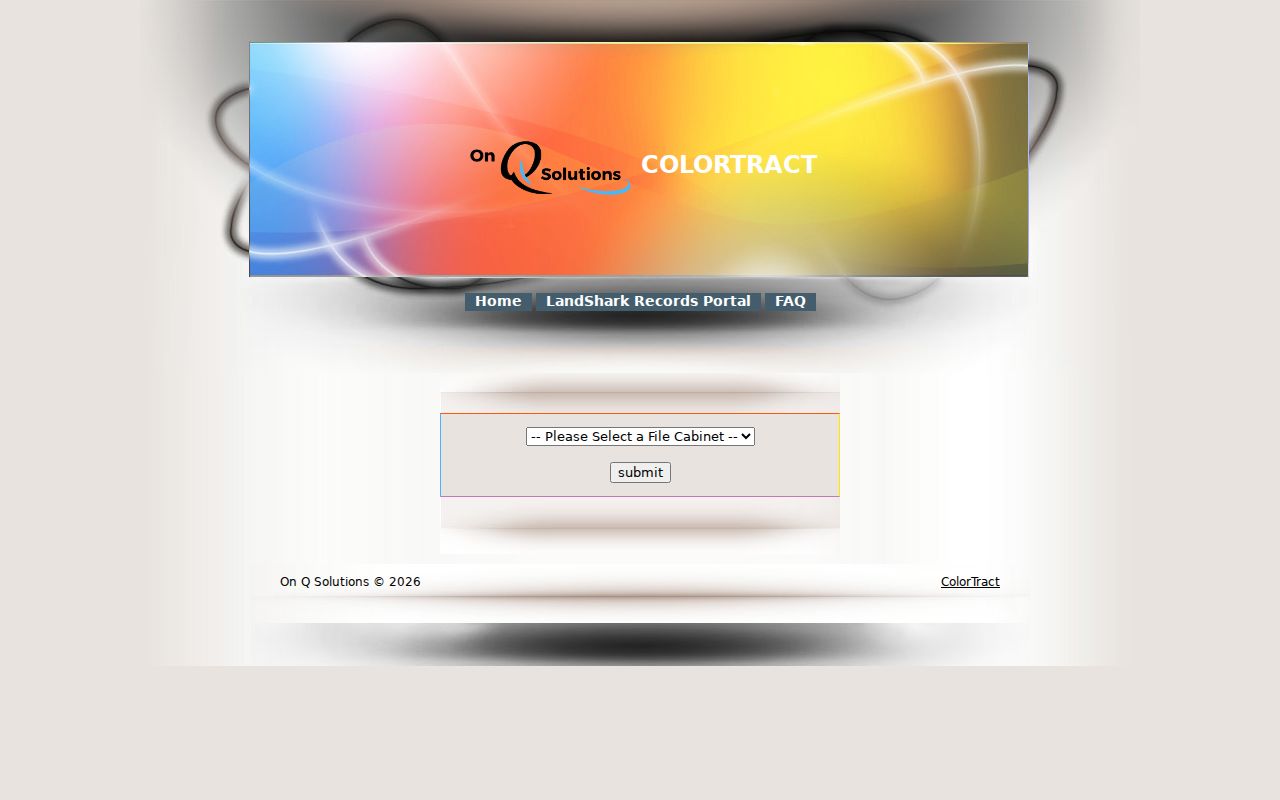
Multiple county index paths branch out from that landing page. Pick the tract route for land-based checks and the document index for a recorded instrument's history.
Fields in Clark County Deed Records
A deed number or type opens each entry. The historic Clark County deed inventory described by the UW-Eau Claire finding aid also records the date, grantor, grantee, and property description. Witnesses, the amount paid, the recording date, and a notarial acknowledgment round out the record. Similar names blur together in old deed records. These fields let you tell them apart. They also let you follow the land itself instead of trusting a single name match.
| Parties and date | Grantor, grantee, deed date, and recording date |
|---|---|
| Land identity | Property description, including the words needed to compare the same parcel |
| Instrument detail | Deed number or type, witnesses, amount paid, and notarial acknowledgment |
Treat the amount paid carefully. A historic deed may show a nominal sum. It may instead record a family transfer. Neither is a market appraisal. The recording date differs from the signing date too. Parties often signed well before the deed reached the recorder. Keep both dates when you build a Clark County deed timeline.
Clark County Grantor-Grantee Chain
The grantor conveys the interest. The grantee receives it. In the Clark County grantor-grantee index, start with the current grantee and work back to the deed that moved the parcel. That deed's grantor becomes your prior owner. Search that name next. When names or addresses shift over time, the tract index helps, though every link in the chain must still match the legal description of the parcel.
- Locate the newest deed with the present owner as grantee.
- Record its grantor, recording date, instrument reference, and full property description.
- Search that grantor as a grantee in the earlier period and compare the land description.
- At the computer-index edge, ask the Register of Deeds for the paper or tract resource.
- Grantor
- The person or entity conveying the stated interest.
- Grantee
- The person or entity receiving the stated interest.
- Chain of title
- The linked sequence of recorded transfers for the same land.
- Book/page or instrument number
- A reference used to locate a recorded document in the county record system.
Clark County's 1856–1916 Deed Reels
Clark County deed research runs deeper than most people expect. Sixteen reels of 35mm microfilm hold the "Clark County (Wis.) Register of Deeds: Deeds, 1856–1916" collection. They are held through UW-Eau Claire Special Collections. Each entry records the parties, land descriptions, dates, amount paid, and acknowledgment details. That is a rich run of deed records. The catch is the index. The grantee and grantor index stops at 1885, while the deed reels continue to 1916.
So the documents outlast their name index. For a Clark County owner history in that gap, the post-1885 index path matters. Ask the Register of Deeds about it. For the earlier indexed years, the finding aid is the right tool. The public microfilm collection is too. Bring a reel number or deed number. That works far better than a broad request for every record tied to one surname.
See the UW-Eau Claire finding aid for Clark County deeds.
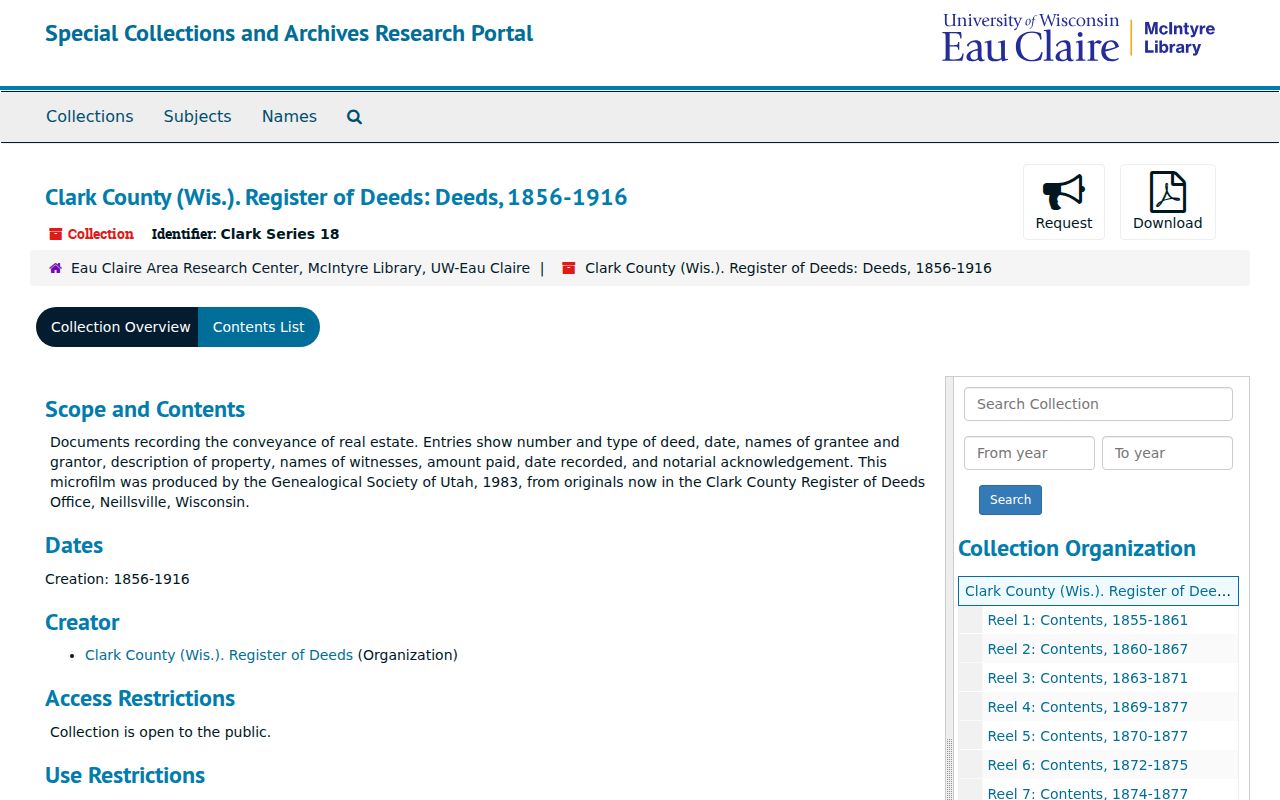
The finding aid lays out the collection span and how the index relates to it. It helps you route a request. Still, the reel and the deed must be read against the parcel description itself.
Clark County Mortgages and Liens
Deeds are only part of what Clark County records. The Register of Deeds also holds mortgages, satisfactions, assignments, easements, covenants, lis pendens, federal tax liens, and UCC fixture filings. Know what each instrument means. A mortgage secures a debt; it does not convey ownership. A satisfaction or release shows a lender's claim was discharged. An assignment can change the lender without touching the parcel owner.
Search by owner name, lender or entity, parcel description, and date range. Do not tie a judgment against a similarly named person to a parcel. The recorded document must name that land. For foreclosure context, match a WCCA case to the lis pendens, judgment, or sheriff's deed recorded with the county. Remember that a lien check is just one piece of a full title review.
Requesting a Clark County Deed Copy
There are several ways to get a Clark County deed copy. Use the linked LandShark or Tapestry route when it returns the document. You can also contact the Register of Deeds at the courthouse. The office issues certified and non-certified copies once the proper fee arrives. The public landing page posts no fee schedule, so confirm the amount before ordering. Do not apply GIS map-print prices to recorder copies.
For an office request, include the grantor and grantee names. Add the recording date or date range, the parcel number, and the legal description. Include any document reference you have as well. Ask whether your copy needs to be certified. If a current index misses an older instrument, explain the time period. Then ask which paper index, tract book, or microfilm resource fits. The Clark County office helps users locate a record. It also manages access to protect the record set.
Keep two dates straight. The deed may be signed on one date and recorded much later. An index or image viewer also has its own coverage boundary. If you are chasing a prior transfer, identify the newest grantee. Then ask staff which paper index covers the next period back. A request built on parties, land description, and date range works best. A surname-only search could return unrelated parcels.
The separate Tapestry EON deed-search page is another route listed with the county deed resources.
The Tapestry page identifies the alternate deed-search service. Confirm its current charges and document access terms before ordering or relying on an image.
Recorded, not guaranteed. An index result confirms an instrument was recorded, but it is not a title opinion and does not reveal every unrecorded interest. A title professional reviews the chain and exceptions before someone relies on clear ownership.